
V-STUD & T-Grip liners for concrete structures


BG Plast’s V-STUD & T-Grip liners extrusion line is designed for the production of liners intended for the internal lining of concrete structures, such as large-diameter pipes, tanks and infrastructure projects. In these applications, the need to ensure durability, chemical protection and friction reduction has historically led to the use of ceramic linings, which, however, are characterized by high production costs and complex processes.
To meet these challenges, an alternative technology has emerged based on the use of thermoplastic liners, specifically HDPE, capable of delivering equivalent – if not superior – performance with a significant economic advantage. BG Plast, an expert manufacturer of extrusion and calendering lines, has developed specific systems for the production of liners with V-Stud and T-Grip geometries, optimized for direct integration into concrete during the pouring phase.
Applications of V-Stud and T-Grip liners
V-Stud and T-Grip liners are used in all contexts where internal protection of concrete is required against the erosive, chemical, or mechanical action of transported fluids. They are used as protective linings for concrete, particularly in large concrete pipes designed for water conveyance, where they facilitate flow and reduce pressure losses.
Additional applications include drinking water tanks, containment structures, concrete tunnel construction, and, more generally, all infrastructure projects where protecting the structure is essential for long-term durability. The “T”- or “V”-shaped plates allow for perfect anchoring in fresh concrete and transform the liner into a single unit with the structure once solidification has occurred.
Technical specifications of the BG Plast T-Grip and V-Stud Line sheet extrusion line
V-Stud and T-Grip liners are manufactured using an extrusion line combined with a calender, specifically designed for forming complex geometries. At the heart of the system is a calender equipped with shaped rollers, engineered to create the characteristic longitudinal ribs that guarantee mechanical anchoring in concrete.
Thanks to a highly efficient cooling system, our equipment is capable of producing sheets with a flat section thickness of up to 5 mm, a value exceeding the standards commonly available on the market. This results in more robust liners, suitable even for demanding applications.
The lines can process various thermoplastic materials, including HDPE, LDPE and PVC, depending on application requirements. Sheet widths can reach up to 7500 mm, with machinery suitable for large-format production as well. Production capacity can reach up to 2000 kg/h, with high industrial efficiency.In addition to the standard V-Stud and T-Grip configurations, we are available to produce other geometries upon request, adapting the calender and extrusion line to the customer’s specific needs, as in the case of “V”-shaped sheets used primarily as liners for flat concrete surfaces.
Applications
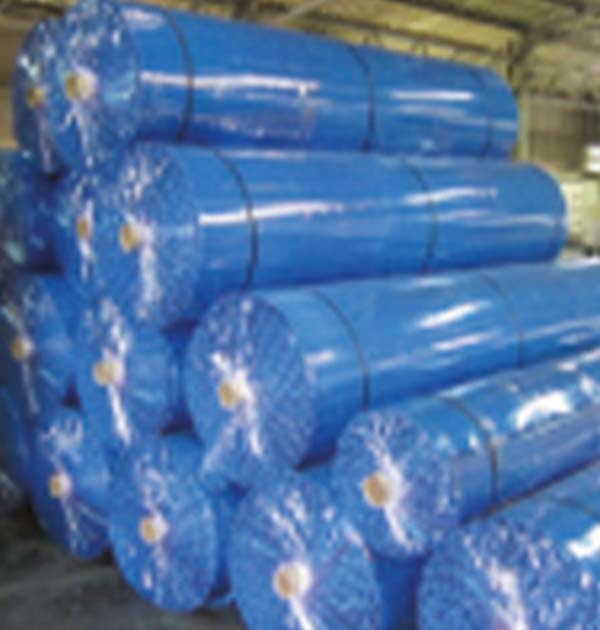


End product examples
Discover some examples of end products made with our solutions. Each result is the outcome of a precise, flexible, and highly technological process, designed to ensure performance, quality, and reliability in every application.


BG Plast technology for high-performance technical liners
With the V-STUD & T-Grip liners line, we reaffirm our position as a leading partner in the development of extrusion lines for special applications. Our expertise in designing profiled calenders, combined with process control and design flexibility, allows us to offer reliable, customizable systems designed for maximum integration with the concrete construction process.
BG Plast solutions enable liner manufacturers to produce an advanced technical product, with a focus on reducing overall costs and improving the quality and durability of the final structures.
Discover the evolution of concrete structures.