
Among the plastic extrusion lines we manufacture for our customers, those for positive-drive conveyor belts are one of the most fascinating applications from an engineering perspective.
Manufacturers of these systems are well aware of the meticulous design required: a structural component is created to operate vertically, integrated into automated warehouses, robotic lines or multi-level storage systems. In these applications, the belt cannot slip, stretch under load or lose tooth engagement.
When vibrations, misalignments, abnormal pulley wear or high production scrap rates occur, the first thought is that there is a problem with the compound. In reality, in most cases, the cause lies upstream: in the design of the extrusion and calendering line dedicated to conveyor belts.
TPU extrusion: rheological control and process stability
Is TPU instability during extrusion the problem?
TPU – thermoplastic polyurethane – is currently the material of choice for these applications, thanks to its combination of elasticity, abrasion resistance and chemical stability. But those who work with this polymer are well aware of the complexity of TPU extrusion.
Even before the material enters the extruder, there is a crucial step: TPU preparation. As a hygroscopic material, thermoplastic polyurethane must be properly dried and conditioned using a dedicated preparation unit capable of removing residual moisture and stabilizing the material prior to extrusion.
Inadequate preparation can compromise process stability right from the early stages, leading to rheological variations, surface defects and dimensional instability in the finished product.
Controlling the extrusion temperature of TPU, for example, is a critical factor. Thermoplastic polyurethane is susceptible to thermal degradation: material buildup in the barrel, excessive shear or uncontrolled hot spots can compromise the molecular structure, leading to brittle teeth, loss of resilience and dimensional instability.
In a high-performance plastic extrusion line dedicated to timing belts, the extruder cannot be a standard model. The extrusion screw for TPU must be designed to:
- ensure uniform plasticization
- reduce excessive shear
- avoid dead zones
- maintain constant melt viscosity.
In our extrusion and calendering lines, multi-zone temperature control is integrated with continuous pressure monitoring systems. The inclusion of a melt pump further stabilizes flow rate and eliminates fluctuations that would result in thickness variations or irregularities in the teeth.
For manufacturers of belts intended for use over tens of meters, consistent flow is essential to maintaining perfect pitch along the entire length.
From the extrusion process to forming the teeth with a calender
Is the problem warped teeth or inconsistent pitch?
A traditional extrusion line is not sufficient when it comes to producing positive-drive belts.
In the case of toothed belts, the calender does not merely calibrate the thickness as in conventional sheet extrusion. It becomes a structural forming element. The cutting roller must reproduce the tooth geometry with extremely tight tolerances.
An error of a few hundredths of a millimeter in pitch may seem negligible over a meter. After 40 or 50 meters, it becomes a mechanical gear problem.
Calendering – a process in which we specialize – allows the geometry to be transferred with millimeter precision onto the still-plastic material, but only if:
- the melt pressure is stable
- the roller temperature is uniform across the entire width
- the line speed is perfectly synchronized.
Among the advantages of calendering over pure extrusion, in this case, the ability to simultaneously control thickness, tooth geometry and cooling is fundamental, reducing differential shrinkage and internal stresses.
BG Plast extrusion and calendering lines are engineered as a single system: the extruder, die head and calender operate in dynamic equilibrium, not as independent units.

Millimeter-precise extrusion and calendering for results that guarantee continuous efficiency in conveyor belts: with BG Plast solutions
Dimensional stability: reinforcements and tension control for TPU conveyor belt extrusion lines
Does the belt curve vertically with a “banana effect”?
Stability under load for vertical conveyor belts is a structural variable. Uncontrolled elongation alters the tooth pitch and compromises synchronization with the pulley.
For this reason, the integration of aramid or polyester reinforcements during extrusion is a recommended practice. However, the real challenge lies in controlling tension and centering during this process.
In a thermoplastic extrusion and calendering system specifically designed for this application, the cord feeding system is electronically synchronized with the line speed and the screw throughput.
Even a minimal difference in tension between the right and left sides causes longitudinal curvature. The so-called “banana effect” is not merely an aesthetic defect: in a vertical elevator, it leads to lateral drift, friction on the guides and premature wear.
Our BG Plast solutions incorporate tension control systems that ensure structural symmetry in every extrusion process.
In-line inspection and production efficiency
Is high scrap a problem?
Manufacturers of belts for highly automated applications understand the importance of quality for optimal performance in the field, and that this cannot be verified solely through sampling, but requires continuous monitoring.
The addition of laser measurement systems for thickness and width allows for a significant increase in efficiency on the extrusion line because it is possible to intervene in real time on any deviations. The reduction in production scrap, depending on the complexity of the profile, can reach 15–20% in critical phases, with a direct impact on the cost per meter produced.
Furthermore, an optimized design of the extrusion system also affects overall energy consumption. Process stability means fewer restarts, less material waste and reduced mechanical stress on components.
Therefore, when evaluating the cost of an industrial extrusion machine, it is necessary to consider the system’s lifecycle: production continuity, ease of maintenance and long-term accuracy.
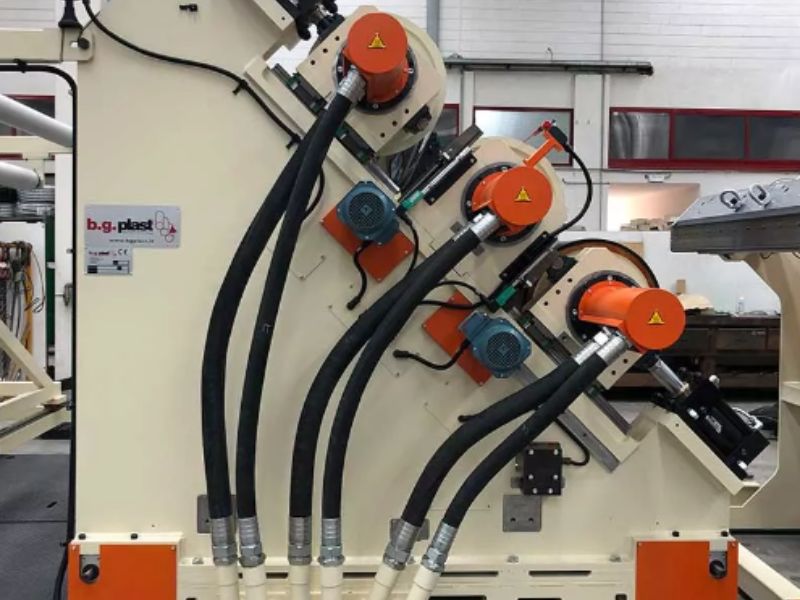
Custom design that delivers optimal extrusion temperatures: choose BG Plast lines for the production of your positive-drive conveyor belts
Not just a machine, but a process system
When selecting a supplier for plastic extrusion lines, the difference lies in the system design.
A generic plastic extrusion machine or a line designed for film or profiles cannot guarantee the performance required by a line for positive-drive conveyor belts intended for vertical operation.
You need:
- dedicated screw design for TPU
- strict control of material extrusion temperature
- pressure stabilization
- high-precision forming calender
- integration of reinforcement systems
- continuous dimensional control.
We are able to offer complete process solutions, custom-designed and built, representing the culmination of the know-how we have built up over nearly 40 years of experience.
Is your conveyor belt designed to operate with zero margin for error?
If your conveyor belt needs to operate vertically, without slippage and with zero margin for error, the real question isn’t which TPU to use, but whether the upstream extrusion line has been designed to provide rheological stability, geometric precision and dimensional control over tens of meters.
If the conveyor belt works, no one notices, but if it jams, the entire downstream system stops.
For this reason, the quality of a conveyor belt line begins long before installation, in the design of the plastic extrusion system—the TPU is essential for the system to function correctly.
Extrusion and calendering lines for positive-drive conveyor belts are not a simple evolution of sheet and film extrusion, but a highly engineered application of the thermoplastic extrusion process, where every component of the line contributes to the belt’s final performance.Precision starts with a design: contact us to find out how.