
In the extrusion of flexible thermoplastic materials, TPU (thermoplastic polyurethane) and PVC (polyvinyl chloride) are undoubtedly two of the most popular choices for the production of technical membranes. Both used in numerous industrial applications, they have similar characteristics but also fundamental differences that determine their suitability for specific uses.
Knowing the differences between TPU and PVC is essential for choosing the most suitable solution in terms of performance, sustainability, and cost. Let’s analyze the main technical peculiarities, typical applications, and technological solutions offered by BG Plast for the production of high-quality membranes.
Composition and technical properties TPU and PVC membranes
TPU (Thermoplastic Polyurethane)
TPU is a thermoplastic elastomer that features high elasticity, wear resistance, and remarkable mechanical stability even at low temperatures. Its main characteristics include:
- Excellent resistance to abrasion and chemicals
- Flexibility and resilience even under prolonged mechanical stress
- High optical transparency
- Biocompatibility and nontoxicity
- Wide hardness range (Shore A60 to D85)
- Cold resistance down to -35 °C without any drop in performance
- Absence of plasticizers and phthalates, for a more environmentally friendly solution.
PVC (Polyvinyl Chloride)
PVC is a rigid or flexible (if plasticized) plastic valued for its good balance of cost and performance. Among its main characteristics:
- Good mechanical and chemical resistance
- Low cost and wide availability
- Fair resistance to moisture and weathering
- Variable transparency.
Disadvantages, which can be mitigated with good extrusion technique, include odor emission and the presence of plasticizing additives. Also to be considered is the tendency to yellow over time.
While PVC performs well in standard conditions, TPU provides superior performance in extreme conditions and critical applications.
Direct comparison of TPU and PVC
| Feature | TPU | PVC |
| Elasticity | High and with recovery | Low, almost absent |
| Abrasion | Very resistant | Moderately resistant |
| Operating temperature | Up to -35 °C | Up to -10 °C |
| Odor | Odorless | Pungent odor |
| Trasparency | High, slight yellowing | Bluish or yellowish |
| Environmental | Recyclable, phthalate-free | Difficult to recycle, containd phthalates |
| Cost | Medium-high | Low |
TPU is therefore ideal for applications that require high elasticity, chemical and environmental resistance, while PVC is an economical choice that is still good for standard and undemanding uses.

Applications of TPU and PVC membranes include waterproof roofing
Applications of extruded TPU and PVC membranes
Flexible TPU and PVC membranes find wide use in industrial and technical fields. The choice of material depends on performance, durability and regulatory compliance requirements.
Where TPU membranes are used
Due to its versatility, TPU is used in:
- Medical industry, for catheters, respirator membranes, skin contact devices
- Automotive industry, for flexible seals, noise protectors
- Technical clothing, for breathable membranes for outdoor use, sports footwear
- Industrial packaging, for protective films for electronic devices
- Construction sector, for waterproof sheeting, anti-vibration membranes.
Uses of PVC membranes
PVC is popular in applications that tend to be less heavy-duty, but depend greatly on the quality of extrusion:
- Coatings for electrical cables
- Waterproof sheets for swimming pools or roofs
- Films for curtains, industrial roofing
- Coatings for building materials
- Economical flexible packaging.
Plasticized PVC is also commonly used for weldable membranes that are easy to work with, but have lower mechanical properties in the long run than TPU.
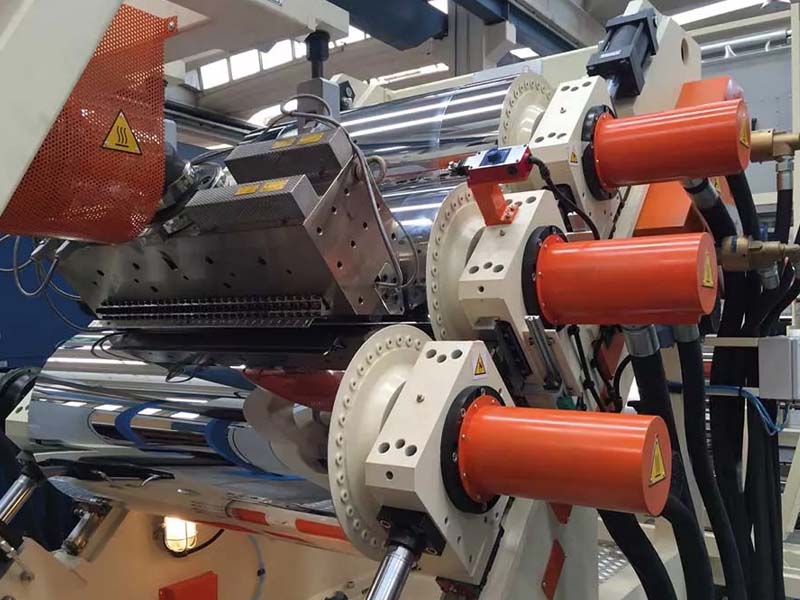
BG Plast’s coating lines combine the precision of calendering with the best technology for sectors ranging from the automotive industry to the trade show industry
BG Plast solutions for extrusion of TPU and PVC membranes
BG Plast designs high-performance extrusion and calendering lines for the production of technical membranes in TPU, PVC and other thermoplastic materials. The technologies developed make it possible to meet the requirements of the most demanding industries in terms of surface quality, thickness accuracy, and multilayer composition.
Coating and laminating lines for TPU and PVC
Suitable for processing TPU, TPU + fabric, expanded or compact PVC, extrusion lines are made to produce single-layer, 3-layer or 6-layer membranes, sheets and panels.
For single-layer coating lines, thicknesses range from 0.1 to 5 mm, with useful widths from 1,500 to 2,500 mm and a production range of up to 1,000 kg/h.
Three-layer production combines PVC, TPU, industrial fabrics, nonwovens and carpeting. Thicknesses from 0.1 to 2 mm, useful width up to 6,000 mm.
Six-layer lines also include virgin and recycled PP, natural fibers, Kevlar, nonwoven, industrial fabrics and carpeting for outputs up to 4 mm thick and widths up to 6,000 mm,
The combinations of three different polymers and three natural fibers allows endless applications to meet every need and special requests, such as the production of positive tension tapes. Our line also makes rigid panels to be thermoformed as car doors.

Example of standard configuration of glass reinforced with polycarbonate
Calendering systems and automation
Extrusion coating lines are designed with calenders of up to 3 cylinders for a homogeneous surface finish and ensure optimal pressure and temperature control for sensitive materials such as TPU. Flexibility in cylinder geometry is the key to adapting to required thicknesses. While advanced technology and automation help simplify the process for even more efficient results:
- Digital temperature control to ensure uniformity
- Automated longitudinal and transverse cutting
- Controlled winding for tension and alignment
- Real-time monitoring of thickness and temperature.
TPU or PVC? BG Plast for consistently efficient custom extrusion lines
The choice between TPU and PVC for technical membrane production depends on multiple factors, including required performance, durability, environmental compatibility, and cost. TPU stands out for superior performance in terms of elasticity, chemical and environmental resistance, while PVC is a reliable economic solution for less critical applications.
The extrusion and calendering lines developed by BG Plast are designed to respond flexibly and efficiently to both production scenarios, with technologies suitable for processing both high-performance materials such as TPU and standard PVC solutions.
Choosing the right plant means guaranteeing membrane quality, reducing operating costs and effectively meeting the challenges of an ever-changing market. Discover the extrusion of the future, today, with BG Plast: contact us.