
When designing infrastructure intended to operate in particularly critical environmental conditions, the choice of materials is essential. High temperatures, intense solar radiation, significant temperature fluctuations, saline soils, and water scarcity require performance standards that are much higher than those of ordinary climatic contexts.
In major civil and environmental engineering works carried out in these environments, such as in the Middle East — water infrastructure, foundations for complex buildings, controlled landfills, artificial basins, and urban drainage systems — HDPE geomembranes and high-density polyethylene dimpled membranes are confirmed as among the most technologically advanced, strategic, and resistant solutions available on the market. This is not a recent trend, but the result of decades of development in the extrusion processes of thermoplastic sheets and membranes, with increasingly specific attention to the most demanding operating conditions.
Next month, we will bring these technologies to the spotlight in the Middle Eastern market by participating in Saudi PPP 2026, the international trade fair dedicated to the construction, infrastructure, and civil engineering materials sectors, scheduled to take place in Riyadh from 21 to 24 June 2026. We will be present at Stand 4-208.
Why HDPE is the reference material for geomembranes and dimpled membranes in hot climates
High-density polyethylene is one of the preferred polymers for applications in harsh environments. Its intrinsic properties, chemical inertness, tensile strength, impermeability to fluids, low relative density, and fusion weldability, make it suitable for an extraordinarily wide range of applications. However, it is in extreme climatic conditions that its competitive advantage over other materials becomes clear.
In the Persian Gulf and Arabian Peninsula, daytime temperatures regularly exceed 45°C in summer, night-time temperature fluctuations are significant, solar radiation is among the most intense in the world, and soils often have a high concentration of sulphates and salts. This is a context that severely tests any waterproofing or water management system based on traditional materials such as concrete or bituminous membranes.
Extruded HDPE, by contrast, maintains its structural stability across a very wide thermal range, is not subject to degradation caused by soil salinity, and, when formulated with suitable UV stabilizer packages, preserves its mechanical properties even after years of direct exposure to solar radiation.
Waterproof HDPE Geomembrane: advantages in infrastructure projects in arid environments
A waterproof HDPE geomembrane is essentially a continuous physical barrier, produced by polyethylene extrusion, designed to prevent the migration of liquids, gases, and contaminants through the ground or within artificial structures. Its hydraulic conductivity is in the order of 10⁻¹³ cm/s, a value that is essentially equivalent to total impermeability.
In arid and semi-arid regions, this characteristic is of primary strategic importance. In the countries of the Middle East and North Africa, where water scarcity is one of the main structural challenges, the use of high-density polyethylene geomembranes to line storage basins, irrigation canals, and tanks makes it possible to drastically reduce losses caused by infiltration into the soil. Where water is a critical resource, every square metre of correctly installed barrier corresponds to measurable water savings.
An HDPE high-density polyethylene geomembrane guarantees:
- Absolute impermeability
La geomembrana impedisce infiltrazioni nel terreno e dispersioni di liquidi, proteggendo falde acquifere e strutture artificiali. È particolarmente utilizzata nei bacini di accumulo idrico per ridurre le perdite e migliorare l’efficienza delle infrastrutture idriche.
- Chemical and saline resistance
Highly saline soils and the presence of corrosive agents are among the main critical issues for civil works. HDPE is chemically inert and resistant to acids, sulphates, hydrocarbons, and industrial leachates.
- Service life of over 50 years
Properly designed and installed geomembranes offer an extremely long service life, reducing maintenance costs and extraordinary interventions. For major infrastructure works, this aspect is decisive in the evaluation of TCO (Total Cost of Ownership.)
- UV resistance
In environments with high solar exposure, UV stabilization becomes an essential requirement. Geomembranes produced with high-precision extrusion lines maintain consistent performance even in the presence of intense radiation and high temperatures. The HDPE used to produce quality geomembranes includes stabilizer packages based on carbon black (typically 2/3% by weight) or HALS-type UV stabilizers, Hindered Amine Light Stabilizers, which significantly extend the material’s service life under direct solar exposure.
- Thermal stability
Extruded HDPE maintains its characteristic mechanical properties (elastic modulus, elongation at break, and puncture resistance) within an operating range that extends well beyond 60°C under continuous service conditions, without significant weakening or creep phenomena. This is a substantial distinguishing factor compared with modified bituminous membranes, which are subject to deformation and dripping in applications exposed to high temperatures.
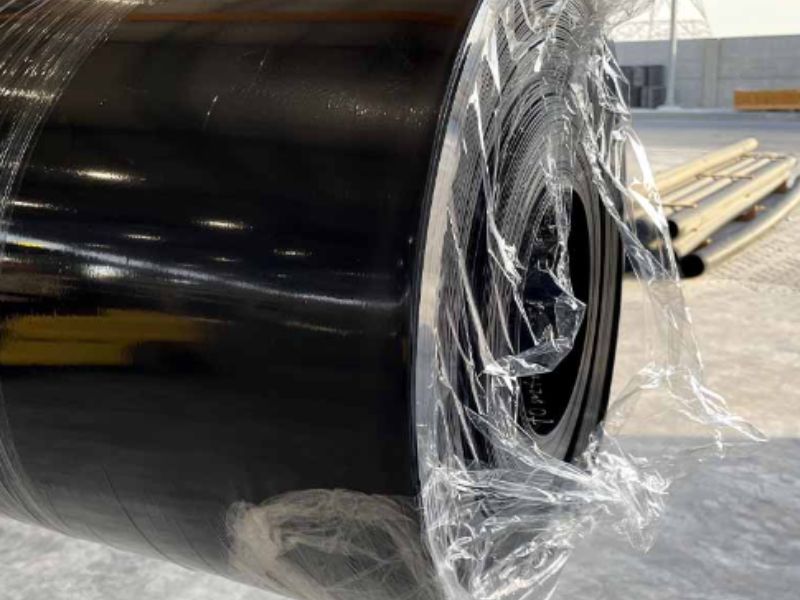
Production of Large-Size geomembranes with BG Plast Extrusion Lines
BG Plast Extrusion Lines for dimpled membrane: specific technology for post-consumer materials
BG Plast extrusion lines for geomembranes are configured to process HDPE and LDPE, with the possibility of producing smooth or textured membranes, particularly in demand for applications on slopes or ramps where it is necessary to increase slip resistance between the layers of the waterproofing system.
With our geomembrane extrusion machinery, it is possible to reach widths of up to 8,000 mm, production outputs of up to 2,000 kg/h, and thicknesses from 0.8 to 3 mm. We can therefore meet the needs of major infrastructure projects, reducing the number of joints during installation and improving the continuity of the waterproof barrier.
The main applications include:
- HDPE geomembranes for landfills
- lining of basins and reservoirs
- hydraulic works and canals
- tunnels and civil infrastructure
- agriculture and water storage
- mining industry and liquid containment
Waterproof HDPE Geomembrane: advantages in infrastructure projects in arid environments
While the geomembrane acts as a waterproof barrier, the HDPE dimpled membrane performs a complementary function of drainage and mechanical protection. It is a product mainly intended to protect waterproofing systems for foundations and retaining walls, drain groundwater and rainwater, and create a technical cavity that allows ventilation of underground structures.
The dimpled membrane is a thin HDPE sheet with a surface shaped into raised elements, or dimples, of defined geometry. It is produced by extrusion on a forming cylinder equipped with thousands of shaped cavities, integrated with a high-efficiency vacuum suction system. The three-dimensional morphology gives the product mechanical properties far superior to those of a flat sheet of the same thickness: compressive strength varies according to the density and geometry of the dimples, reaching values from 15 to 35 t/m² in standard versions.
In Middle Eastern construction, where foundation ground loads are often high and soils may be subject to differential settlement, structural strength is an essential design requirement.
The dimpled membrane performs three additional functions in a complete construction system:
- Mechanical protection of waterproofing
During backfilling operations, granular material can puncture or tear the underlying waterproof membrane. The dimpled membrane, installed as a protective layer, distributes point loads and prevents damage to the waterproofing.
- Water drainage
The channels formed in the cavity between the flat base and the raised dimples create a continuous network of flow paths, allowing gravity water to drain away without creating hydrostatic pressure against the masonry. In environments with intense seasonal rainfall, such as that which also occurs in some areas of the Arabian Peninsula during the winter months, the drainage system is fundamental to the durability of structures.
- Ventilation and interruption of capillary rise
The air cavity created by the dimpled geometry breaks the capillary continuity between moist soil and masonry, reducing rising damp in structures and improving the hygrometric conditions of underground environments. In the presence of saline soils, the ventilation layer also helps slow the penetration of sulphates and chlorides into concrete structures, which is one of the main causes of building deterioration in the Middle Eastern region.
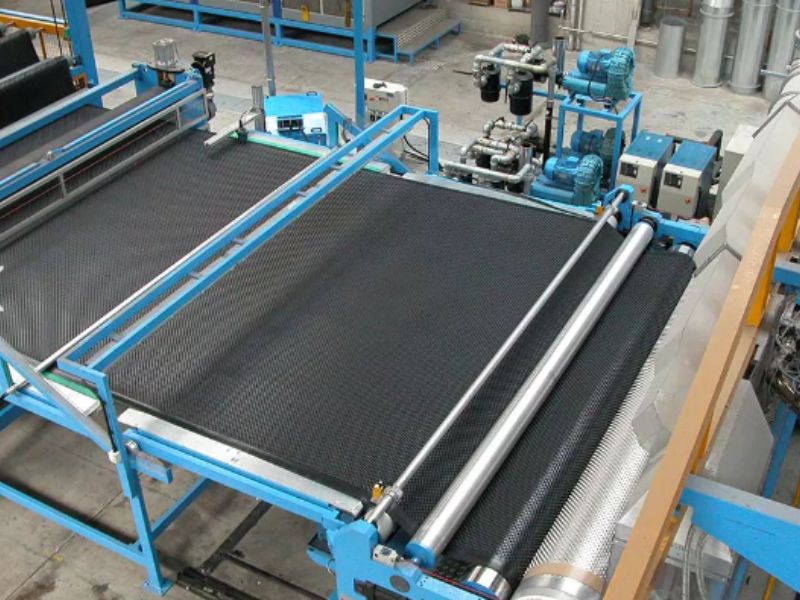
BG Plast HDPE Dimpled Membrane Extrusion Lines for More Efficient Production and More Resistant Extruded Products
BG Plast Extrusion Lines for dimpled membrane: specific technology for post-consumer materials
The production of HDPE dimpled membranes from post-consumer recycled material presents specific technological challenges that require specially designed plant engineering solutions. Recycled material, granules or flakes from separate waste collection, typically contains variable percentages of oils, greases, surfactants, and other contaminants that interfere with the extrusion process, causing melt instability, micro-porosity in the final product, and accelerated wear of components in contact with the material.
We have developed the solution to this problem through specific construction choices along the entire material path: from feeding to forming.
The feeding system is designed to handle flakes of variable size and density, ensuring a constant volumetric flow rate despite the inconsistency of the incoming material. The degassing stations, built with high-vacuum pumps,are positioned at critical points of the extrusion screw. The screw profile is designed to absorb the high flow rates required while maintaining flow stability.
Filtration of the molten polymer is entrusted to self-cleaning automatic screen changers, capable of removing contaminating particles down to the smallest sizes. This is an essential requirement because even a small inert particle trapped in a 0.5 mm thick membrane can generate a micro-hole and compromise the integrity of the barrier.
A gear pump guarantees constant flow to the flat die, which in the widest configurations can reach 6,000 mm. The production capacity of BG Plast lines for dimpled membrane ranges from 500 to 1,100 kg/h, with roll widths from 1,000 to 4,000 mm and thicknesses between 0.5 and 0.9 mm.
Saudi PPP 2026: BG Plast and the opportunities of the Middle Eastern market for Geomembrane and Dimpled Membrane extrusion
Saudi PPP 2026, taking place from 21 to 24 June in Riyadh, is the main trade fair dedicated to public-private partnerships, infrastructure, and construction in the Saudi and Gulf markets. Here, major urban, infrastructure, and environmental development projects planned under Saudi Arabia’s Vision 2030 become a space for technical discussion among manufacturers, designers, and clients.
For us, it is a major international opportunity to bring to a rapidly expanding market solutions for the production of HDPE and PVC geomembranes, dimpled membrane lines, and our entire range of systems for the extrusion of thermoplastic sheets and films.
Choosing local production of geomembranes and dimpled membranes is an increasingly widespread and strategic approach that optimizes efficiency and reduces costs. We support those seeking maximum levels of stability and resistance for projects dedicated to the future of construction.
We look forward to seeing you at Stand 4-208.