
Underground infrastructure is an essential part of urban networks and beyond. Gas pipelines, water pipes, power cables and fiber-optic infrastructure form a dense network of utilities running just below the surface, often without excavation crews knowing their exact location. Protecting these networks from accidental damage during excavation work is therefore a technical, regulatory and public-safety priority.
The protection and warning sheets for underground utilities – also known as warning plates, cable protection sheets or underground utility warning sheets – are a well-established solution to this problem. These flat thermoplastic elements are laid above pipelines at a specified depth and perform two functions: provide a visual warning of the utility before excavation equipment reaches it, and absorb or distribute the mechanical impact of site equipment, protecting the pipe or cable below.
The continued expansion of energy infrastructure, water networks and fiber-optic connections is increasing demand for reliable, durable and easily identifiable protection systems: the extrusion of technical thermoplastic sheets is one of the most interesting plastics applications for the infrastructure sector.
What are protection sheets for underground cables and pipelines?
Protection sheets for underground utilities are installed in the trench during backfilling, above a layer of gravel or sand that directly covers the pipe or cable. They are typically positioned 20–40 cm above the utility, in the transition zone between the backfill material and the overlying soil.
As mentioned above, their function is twofold:
- Visual warning. The color of the sheet – standardized according to utility type – provides the first warning to the operator. When the excavator bucket reaches the sheet, the operator immediately knows that sensitive infrastructure lies below and stops mechanized excavation to proceed using a different method. This helps prevent serious and potentially dangerous damage, such as rupture of a gas pipeline or severing of a high-voltage power cable.
- Mechanical protection. The sheet’s rigidity and structural profile must be sufficient to absorb or deflect the bucket impact and protect the underlying utility from accidental strikes. This requirement depends directly on material selection and finished-product thickness.
The most common colors follow internationally adopted conventions, although regulations vary from country to country.
- Yellow: gas networks
- Blue: drinking water
- Red: electric power
- Green or orange: telecommunications and fiber optics
- Black: general-purpose use or with overprinted color markings.
Many sheets are printed with warning messages (“WARNING – GAS”, “ELECTRIC CABLE”, etc.) and some versions incorporate metallic tracer tapes or conductive filaments that allow detection with a metal detector even when the sheet is buried at considerable depth.
Reference standard: UNI EN 12613 and international standards
The UNI EN 12613, which covers “Visual warning devices for underground cables and pipelines”, is the main reference standard for protection and visual warning sheets used with underground utilities. It defines minimum dimensional requirements, mechanical properties, chemical resistance and color specifications, with the aim of ensuring that the warning device remains recognizable and effective over the long term.
The standard also specifies the parameters that the extruded material must meet: tensile strength, elongation at break, resistance to chemicals found in soil (hydrocarbons, sulfates, alkaline solutions), thermal stability across the typical underground temperature range, and long-term color retention.
In addition to UNI EN 12613, supplementary national standards may apply depending on the destination country, covering installation depth, minimum sheet width in relation to the diameter of the protected pipe, and mandatory markings.
Materials for cable protection sheet extrusion: HDPE, PP and PVC compared
Polymer selection is one of the most important technical aspects in the production of sheets for underground utilities. Three main materials are used, each with specific characteristics that make it more or less suitable for particular applications.
HDPE (High-Density Polyethylene)
HDPE is the most widely used material for protection and warning sheets. The reasons are structural: it provides excellent mechanical impact resistance, retains its properties across a wide temperature range, is chemically inert to substances normally present in soil, and provides a service life of several decades. Its relatively low density (0.94–0.96 g/cm³) makes it lightweight and easy to handle on site, reducing installation times. HDPE is also particularly attractive for projects focused on sustainability, thanks to the possibility of using recycled or post-consumer material.
HDPE sheet extrusion lines can produce variable thicknesses – typically 1 to 3 mm for this specific application – with widths that can reach several meters in the most advanced configurations, reducing the number of longitudinal joints during installation and improving continuity of protection.
PP (Polypropylene)
Polypropylene is a valid alternative to HDPE, particularly valued for its higher rigidity at the same thickness and improved mechanical resistance to direct impacts. PP is compatible with co-extrusion processes, enabling sheets with differentiated layers: a high-rigidity structural core and colored surface layers or layers with specific properties (for example, UV additives or impact modifiers).
PP sheets tolerate slightly higher operating temperatures than HDPE and offer good chemical resistance, making them suitable for contaminated soils or environments where hydrocarbons are present. They are used especially in applications where handling and on-site installation are important factors.
PVC (Polyvinyl Chloride)
Rigid PVC is selected when structural rigidity takes priority over flexibility. It is easy to extrude, offers relatively low production costs and is well suited to mass coloration because it is compatible with a wide range of pigments.
However, compared with HDPE and PP, PVC has lower resistance to cyclic thermal stresses in climates with large seasonal temperature variations. For long-term applications in soils with extreme pH values, material selection should be assessed carefully. Ask BG Plast for a technical assessment of your project.
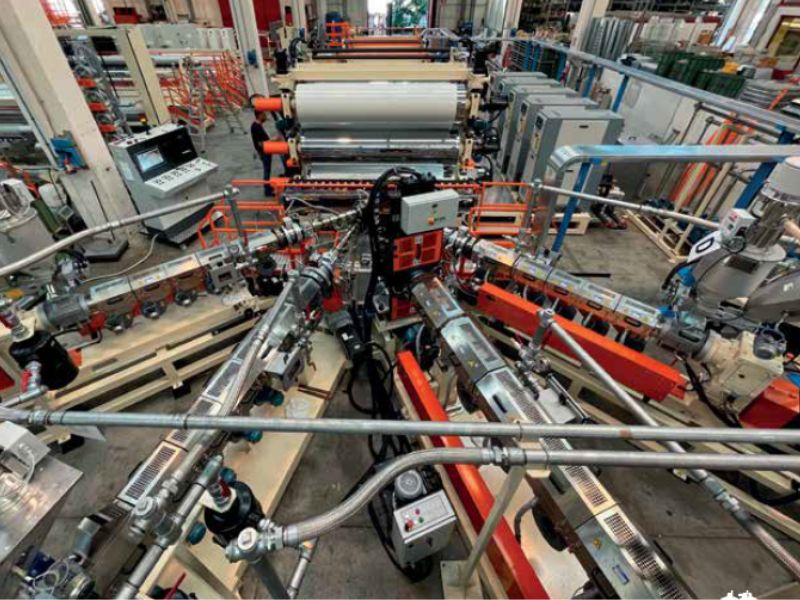
BG Plast calendering: the heart of the cable protection sheet extrusion line
The extrusion process for underground utility protection sheets: key technical variables
The quality of a protection and warning sheet depends to a significant extent on the extrusion process used to manufacture it. The technical variables affecting the finished product are numerous and closely interrelated.
Thickness control
Consistent thickness across the full width of the sheet is a critical requirement. Local variations would create structurally weak areas that could fail under impact. Thermoplastic sheet extrusion lines are equipped with automatic in-line thickness control systems – typically based on X-ray or infrared sensors – that continuously measure the sheet’s cross-web profile and use thermal or mechanical actuators to correct deviations from nominal values in real time.
Calendering and surface finish
The extruded material passes through a calender system that determines its final thickness, flatness and surface finish. For protection and warning sheets, the surface can be smooth or lightly embossed, depending on customer specifications or regulatory requirements. Some versions use a profiled geometry – corrugated or ribbed surfaces – to both optimize the sheet’s mechanical strength and make the impact more noticeable to the excavation operator.
The temperature of the calender cylinders must be controlled with extreme precision because it directly affects internal stresses, sheet flatness and final mechanical properties. Latest-generation calenders such as BG Plast’s incorporate independent thermoregulation circuits for each cylinder, providing maximum control over cooling-water or oil flow.
Mass coloration and color stability
Sheets for underground utilities require uniform, long-lasting coloration that resists both UV exposure (during above-ground storage and transport) and the chemical action of the soil. Color is obtained by dispersing pigmented masterbatch into the base polymer during extrusion. Masterbatch quality and concentration, together with compatibility with the base polymer, determine shade uniformity and long-term color stability.
For sheets intended for markets where mandatory color standards apply, as is the case for gas networks in most European countries, compliance with the specified standard color is verified during acceptance testing.
Tracer tape integration
As noted above, some cable protection sheet versions can integrate one or more tracer tapes during production. These consist of a metallic film (typically aluminum or with a steel core) laminated to the thermoplastic material. This enables electromagnetic location of the sheet, and therefore of the pipeline below, using surface detection equipment without excavation. Integrating tracer tape during extrusion requires a line equipped with dedicated feeding and tensioning systems.
BG Plast extrusion lines for HDPE and PP sheets: capacity and configurations
BG Plast designs and manufactures HDPE and PP thermoplastic sheet extrusion lines with configurations that can be adapted to the specific requirements of manufacturers serving the underground utilities sector.
We design our lines to ensure consistent thickness, dimensional accuracy and uniform mechanical properties across the entire working width of the product. For HDPE sheets, the most advanced configurations offer working widths up to 8,000 mm and outputs up to 2,000 kg/h, with a broad thickness range that also covers typical specifications for underground utility warning sheets.
The material is fed to the TM single-screw extruder – available from TM35 to TM200, with L/D ratios up to 44 for vacuum-degassing models – equipped with a screw and barrel made from special steels (41 CrAlMo7 and 38 CrAlMo7 respectively), standard nitriding treatment and optional bimetallic hard coating for processing particularly abrasive materials or formulations with high pigment loadings, as in colored sheets.
The calender is the heart of the extrusion line. We specialize in the design and construction of calenders for thermoplastic materials. Our systems can process thicknesses from 0.1 to 40 mm thanks to precision electromechanical control of cylinder opening.
Main features include:
- independent cylinder drives;
- dedicated thermal control;
- high clamping force;
- millimetric thickness adjustment;
- dimensional uniformity across the entire working width.
For special products, profiled cylinders can be used to impart functional geometries to the sheet during the extrusion process. Each line configuration is defined from the finished-product specifications: working width, nominal thickness, material or blend, any need for co-extrusion with differentiated layers, and output requirements. We support our customers at every stage, from engineering and in-house testing through to start-up at the production plant.siti di produttività. Accompagniamo i nostri clienti in tutte le fasi, dalla progettazione al collaudo in sede, fino all’avviamento presso lo stabilimento.
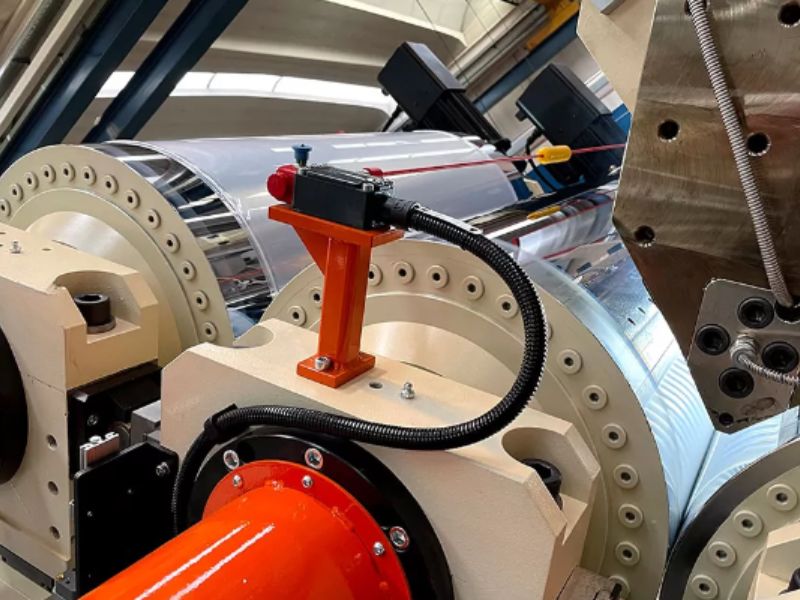
Millimetric details, technical features and custom specifications: BG Plast thermoplastic sheet extrusion lines are built around your production requirements
Underground service life and long-term stability requirements
The long-term stability of cable protection sheets is determined by material selection. A buried sheet is exposed to environmental conditions that change over time: seasonal temperature variations, water and moisture, contact with soils of varying pH, and potential exposure to hydrocarbons or other contaminants in industrial areas.
HDPE and PP, when correctly formulated with appropriate stabilizers, can provide underground service lives of 30–50 years or more, while maintaining mechanical properties and color recognition within regulatory limits. This is especially important for long-life infrastructure, where the cable protection sheet must retain both its protective and warning functions throughout the service life of the pipeline.
The quality of the extrusion process is decisive: correctly plasticized material, with an optimized temperature profile along the extruder, produces a sheet with a homogeneous molecular structure, free of residual stresses, with uniform mechanical properties and ideal distribution of functional additives. Optimized extrusion translates into long-term reliability of the finished product.
BG Plast technology for technical sheet extrusion for infrastructure applications
Protection and warning sheets for underground utilities may appear simple, but they require a well-defined production process to comply with regulatory requirements and deliver the expected performance over time. Material selection – HDPE, PP or PVC – and extrusion-process quality are the variables that determine the product’s actual effectiveness on site and its service life underground.
For manufacturers of warning and cable protection sheets, BG Plast designs and manufactures thermoplastic sheet extrusion lines engineered to optimize finished-product performance and service life, with scalable configurations tailored to each customer’s specific production requirements. Special geometries and additional functions are among our strengths: sheets with reinforcing ribs, impact-resistant surfaces, impact-absorbing geometries and profiled elements to increase mechanical strength. Share your project with us and discover how we can make it even more efficient: contact our experts.